Quick answer
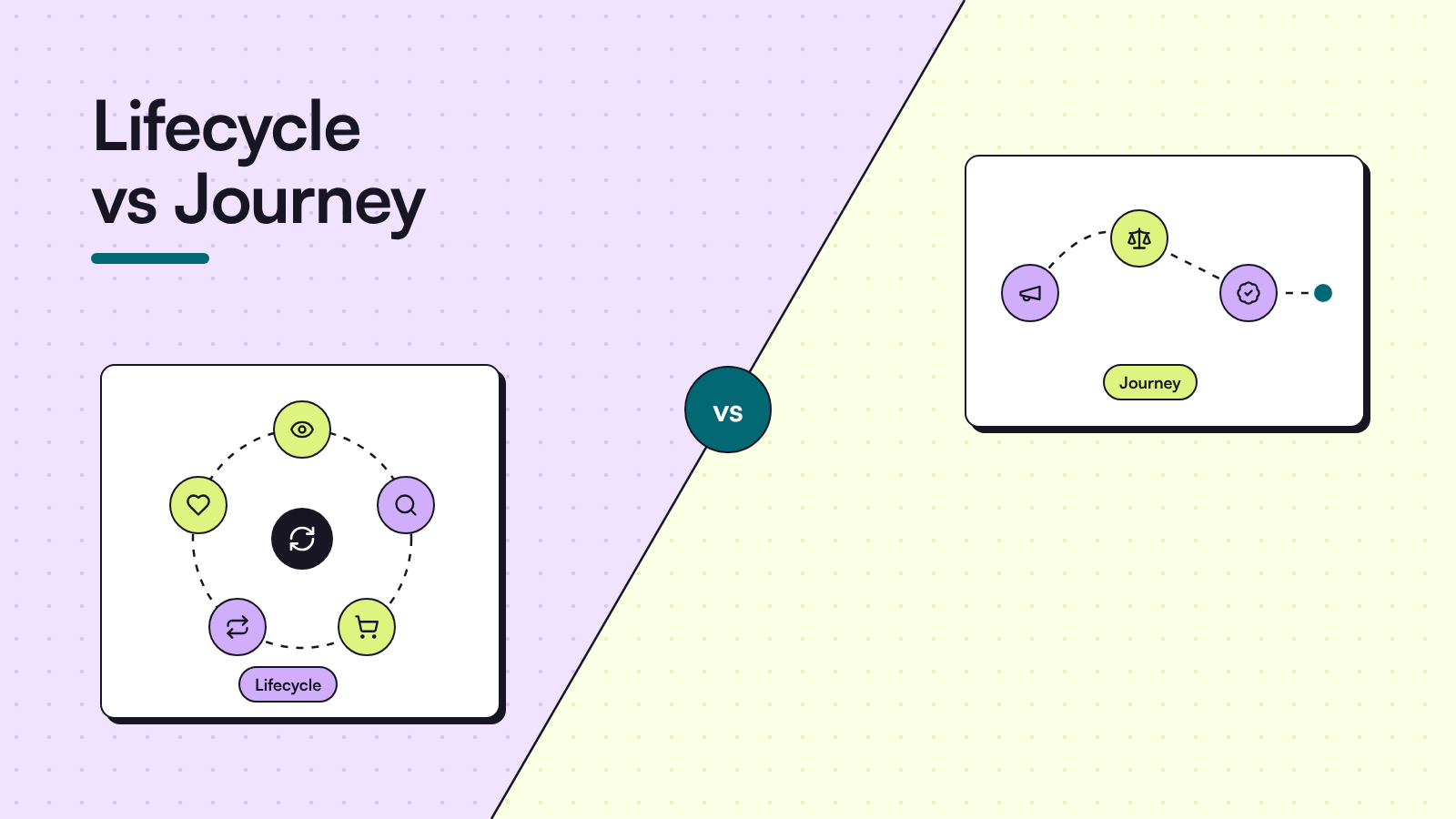
The customer lifecycle covers a customer’s whole relationship with your business, from first awareness through purchase, retention and loyalty, and it keeps repeating. The customer journey is narrower: the touchpoints a customer passes on the way to one purchase or goal, usually awareness, consideration and decision. Journeys sit inside the lifecycle.
Key takeaways
- Lifecycle is a long term loop; a journey is a short path with a clear start and end.
- The lifecycle has five stages: awareness, consideration, conversion, retention and loyalty.
- The journey has three: awareness, consideration and decision.
- Use lifecycle data to plan retention and revenue, and journey maps to fix friction at specific touchpoints.
Customer Lifecycle Is a Complete Cycle of the Customer with the Business whereas Customer Journey focuses on specific paths or interactions.
Assume a customer lifecycle as a river- from the source to the endpoint ocean. And the customer journey is a drop of water into that river. Now, you have the gist of the customer lifecycle vs customer journey battle, right?
Simply put customer lifecycle and journey are two business tools that you can optimize for a better understanding of your customers, resulting in effective action being implemented in your business.
But many get confused and interchange these two terms. That’s why today, I’ve come up with this comparison with an in-depth discussion of all the major differences regarding which one you should focus more on for your business development.
Let’s dive deeper.
What Is Customer Lifecycle?
Customer Lifecycle refers to the journey a customer goes through from finding your business to becoming your customer. A customer lifecycle mapping can help you know your customer better.
It is basically your customer journey analysis tool through which you can find out how your customer is reacting to your business, how he/she is becoming your loyal customer and even how he/she is leaving/returning to your brand. This entire cycle in the marketing funnel is known as customer lifecycle.
Understanding Customer Lifecycle
Understanding the customer lifecycle roadmap is crucial to recreate or change your business plan for a better customer experience. When you track your customer lifecycle roadmap, you can find out how your customer is getting acquainted with your business.
It shows your business from the customer’s point of view analysing customers’ behaviour and decisions, How your customers are coming to your business, whether they are staying on a product page, whether they looking for reviews, checking competitors etc. are observed here in customer lifecycle. And this helps to unlock opportunities for better customer engagement.
In customer lifecycle, there can be both ups and downs. For example, you can find one of your old customers is visiting a product frequently but not purchasing it. In this case, a simple action, such as throwing some discount/coupon or any other offer for that customer might trigger him/her to make the purchase. And this way you retain customer’s loyalty with your business.
CLM (Customer Lifecycle Management ) requires to optimize each stages of a customer with the help of personalized data and behavioural actions to develop better marketing strategies..
In the end, the goal is to increase conversion rate, customer satisfaction, and long-term customer loyalty.
What Are The Phases of the Customer Lifecycle?
There are 5 main stages or parts of customer lifecycle. Customer lifecycle observes and analyse each stages to find out customer’s needs, goals, pain points, and implement necessary improvements to develop a better customer relationship management (CRM).
The main 5 parts of the customer lifecycle are-
- Awareness/ Reach
- Consideration
- Conversion
- Retention
- Loyalty
Businesses nowadays set some metrics and track customers behavioural and other patterns to know how customers are interacting with businesses and what action are they taking. This total process is known as customer life cycle management (CLM). Let’s break down these.
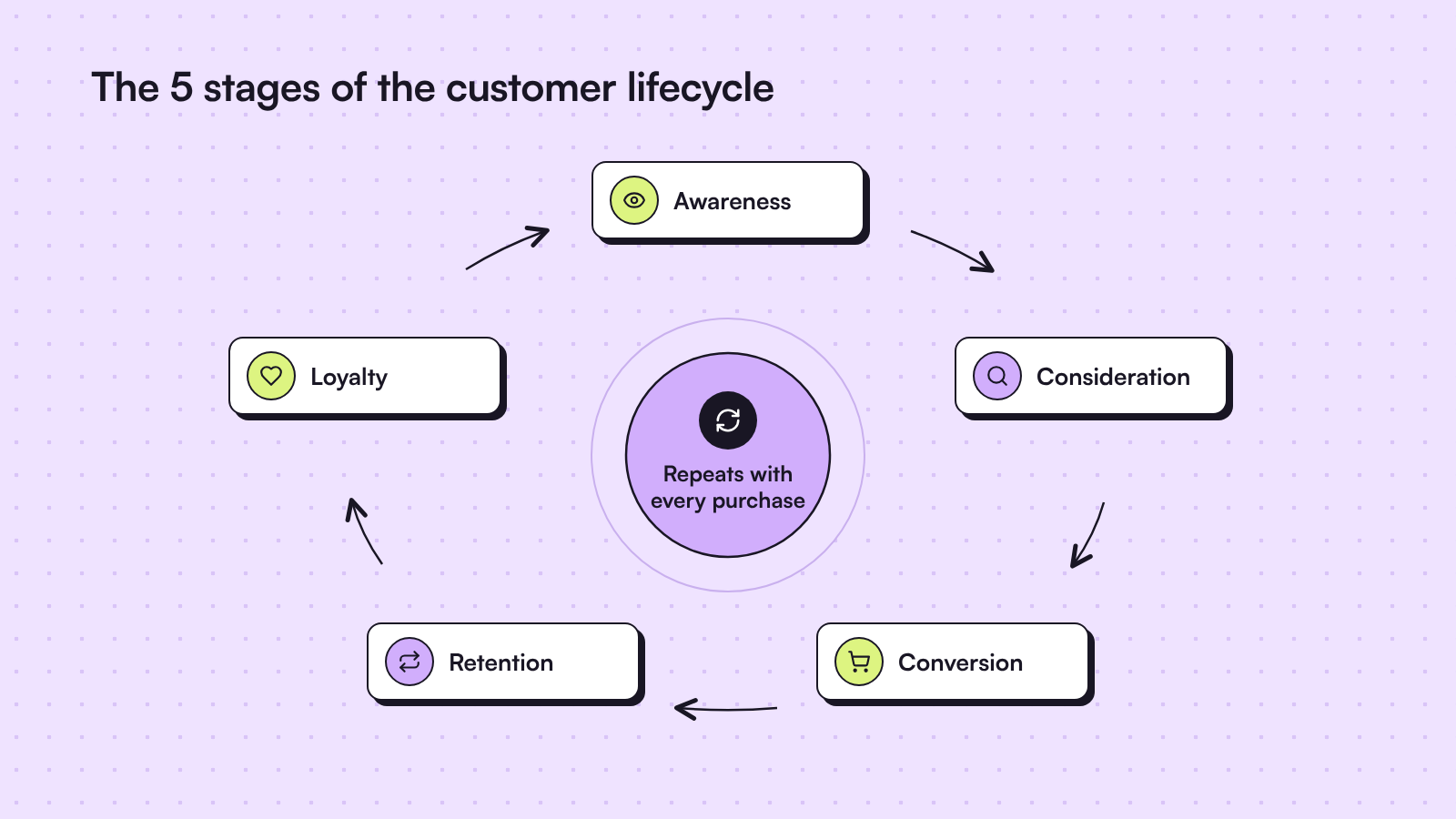
| Stage | What the customer does | What to track | How to move them forward |
|---|---|---|---|
| Awareness | Discovers the brand through ads, search or referrals | Traffic sources, new visitors | Clear messaging and useful content |
| Consideration | Researches and compares options | Pricing page views, return visits, demo requests | Comparisons, reviews, quick answers |
| Conversion | Buys or signs up | Conversion rate, checkout or signup drop off | A smooth checkout or onboarding |
| Retention | Keeps using the product and buys again | Repeat purchases, active usage, churn | Onboarding, support, personalised offers |
| Loyalty | Recommends the brand to others | Referrals, NPS, reviews | Referral programs and rewards |
1. The Spark: Awareness/ Reach
THis is the first stage of your customer’s lifecycle in your business. IN this stage, customer comes to know of your brand. It can form some referrals, internet stumble, ads click so on.
This is where it all begins – the journey of a thousand clicks. So, developing a proper marketing strategy is crucial for building awareness.
2. The Decision Point: Consideration
Now, the spark has turned into a flame of interest. In this stage, your audience research about your business or brand. Your business is being compared with the competitors.
So, in this stage, you need to be more clear and concise about your business. You have to clarify any confusion and provide necessary data to help your audience take the decision.
3. The Leap of Faith: Conversion
The moment of becoming a customer from an audience arrives. In this stage, your customer becomes your customer in exchange for money for goods or services.
But wait a minute. Here, many things can happen. For example, a customer adds a product to the cart but in the time of making payment, he/she changes mind and cancelled the purchase.
So, you need to ensure, the purchase is successful. For this, you must go through all the possible hindrance or use data from previous customer who dropped-off. Find out the hindrances and implement proper actions for purchase completion.
Also read about conversion tracking and how does it works.
4. The Nurturing Stage: Retention
Now, the real work starts. Your customer has completed a purchase. You need to make sure he/she buys form you again.
In this customer lifecycle stage, you need more strategic and personalised approach to hold your customer and make your customer a repeat customer.
Any discount service for second-time purchases or other offers come into play. Besides, taking customer feedback about the purchase can help you more.
5: Farewell But Not the End: Loyalty
SaasQuatch report shows,
80% of the profit of a business comes from only 20% of the repeat customers of that business.
So, retaining your old customer is crucial for every business. You see, if you can increase even 1% of your repeat customers, it can bring 10% revenue increase.
But in the last phase of a customer lifecycel, only a few customers will advocate your brand to others. Unfortunately, some customers will eventually leave. So, defining the reason for a customer’s leave is necessary to find out the drawbacks.
In this stage, creating referral programs with reward system can help retaining customer’s loyalty as well as advocacy.
What Is Customer Journey?
Customer journey refers to the special touchpoints that a customer goes through before and after making a purchase. It can be defined as one of the major parts of customer lifecycle.
Actually, the customer journey directly shows the relationship with your business through some specific touchpoints during the purchase completion.
Though customer journey and customer lifecycle are not the same thing, marketing strategy development goals are pretty similar.
Understanding Customer Journey?
Customer journey can be called the a process invisible to the customers but crucial for the businesses. It is knd of a back-stage process where some defined touchpoints are optimized to improve customer experience.
For example, if you want to buy an Android phone, you go through some phones that are suitable to your preferences. Research different brands and then finally make the purchase from one brand that meets all your goals. All these steps from wanted to buy a phone to bought a phone are customer journey steps.
So, customer journey has a definite start point and end point. And amidst the steps, customer journey mapping can help identifying the customer goals and pain points to improve better customer experience.
Well, you can also learn the ways to apply customer journey analytics tool for long-term customer relationship.
What are The Three Main Parts Of A Customer Journey?
Based on the customer journey map, there are three main stages of customer journey-
- Awareness
- Consideration
- Decision
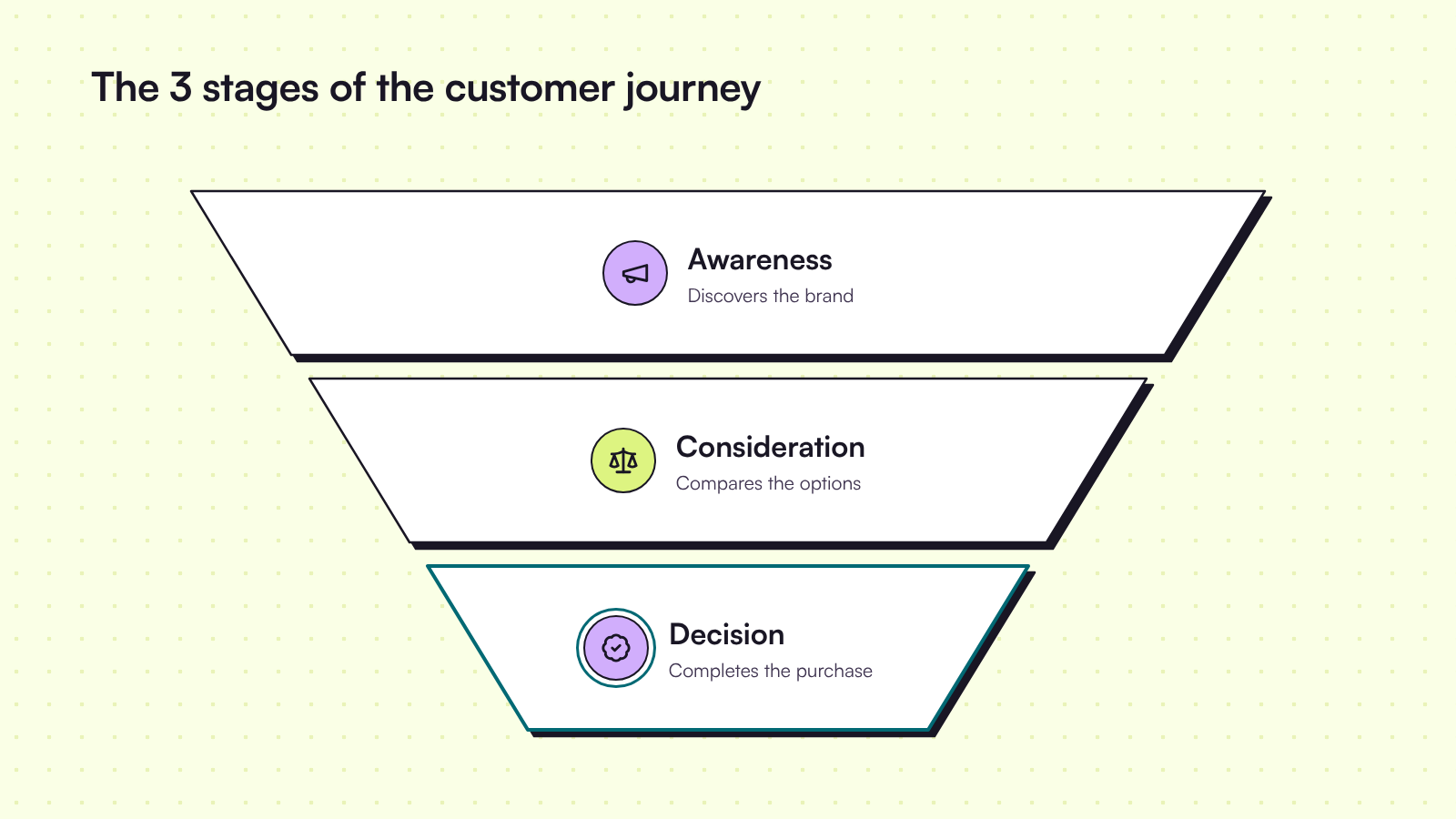
Awareness: The Call to Discover
This is the first stage where the customer discovers your brand. It might be from ads, social media scrolls, or referrals.
In this stage, the customer starts to know your brand, so all the necessary data and answers need to be clear to hook your customer.
Consideration: Trials & Tribulations
In this stage, customer visits your competitors and compare. This is a kind of battle between logic and desire. Here, customer falls in a dilemma whether to buy or not.
A study from Think with Google shows,
Businesses implementing omnichannel(different methods of interaction) strategies for customer interaction get 30% higher customer lifecycle value (CLV) than others without omnichannel shopping.
To help your customer a better design experience here can help the customer tto make a final decision.
For example, you want to buy a phone holder. You are looking different brands and pages and comparing which one to buy. If you find a page featuring the best prices along with a simple and seamless navigation to purchase page, your mind will trigger to buy.
Decision: Triumphant Purchase
This is the final stage of a customer journey where he/she takes the decision to buy and complete the purchase. From here, the customer steps into the journey of a new chapter with your business.
In this stage, a thanking reply after the purchase or asking for feedback after purchase can help improve further customer journey.
Besides, automation tools nowadays, prove to be a gem in maintaining personalised communication with the customer through automates messages, push notifications for new product launch or repeat purchase.
The Main Differences Between Customer Lifecycle Vs Customer Journey
Here we break down the differences between customer lifecycle vs customer journey
| Aspect | Customer lifecycle | Customer journey |
|---|---|---|
| Scope | The whole relationship with the business | One purchase or goal |
| Timeframe | Long term, repeats with every purchase | Short, with a clear start and end |
| Stages | Awareness, consideration, conversion, retention, loyalty | Awareness, consideration, decision |
| Main question | How do customers move through the relationship over time? | Where do customers get stuck on the way to a decision? |
| Best used for | Retention, CLV and revenue planning | Fixing friction at specific touchpoints |
- Customer Lifecycle Is Indefinite Whereas Customer Journey Is Individual Customer lifecycle shows all the stages a customer goes through with a business, from reaching your brand to promoting your brand. On the other hand, the Customer journey is a journey of a purchase from finding the brand to post-purchase
- Customer Lifecycle Tracks Customers’ Behavioural Actions Whereas Customer Journey Tracks Only Purchase Experience Well, in a customer lifecycle too, you can track all the stages a customer goes through. You can track when your customers take a random visit to your business, adding wishlist but not bringing it or sharing your business etc. On the contrary, Customer journey map shows some individual touchpoints with the business from knowing your brands to completing the purchase.
- Customer Lifecycle Is an Analsis Tool But Customer Journey Is a Design-Based Tool: Customer lifecycle is basically an analysis tool to optimize your business for better marketing strategies. On the other hand, the customer journey is a design-based tool that helps implement strategies for better customer experience.
- Customer Lifecycle Is a Complete Cycle of the Customer with the Business whereas Customer Journey focuses on specific paths or interactions, such as a purchase journey. In a customer lifecycle, you can find the overall journey that a customer completes with the business. It is a loop that tactically never finishes. If you can implement better marketing strategies, you can hold your customer and make him/her repeat the cycle with repeat purchases. On the contrary, Customer journey shows some focused touchpoints or steps that a customer goes through while making a single purchase. And the journey ends. For another purchase, another customer journey begins.
- Customer Lifecycle Focuses on Marketing Strategies, But Customer Journey Focuses on Customer Experience Customer lifecycle mapping helps in implementing better marketing strategies from reaching and collecting leads to making them repeat customers. By optimizing customer lifecycle, you can work on the increase of conversion rate and higher CLV (Customer Lifecycle Value). On the other hand, customer journey mapping helps you identify and improve the pain points and gaps in customer experience. Research shows,
80% of consumers like to purchase again from a business that provides a more personalized and tailored experience. By improving customer experience through customer journey, you can get higher engagement rate.
- Customer Lifecycle Is a Long-Term Process. Contrarily, the Journey Is a Short & Fixed Process. In customer lifecycle, you can identify how your customers are interacting with your business over time. On the other side, customer journey is a complete end-to-end experience of making a purchase.
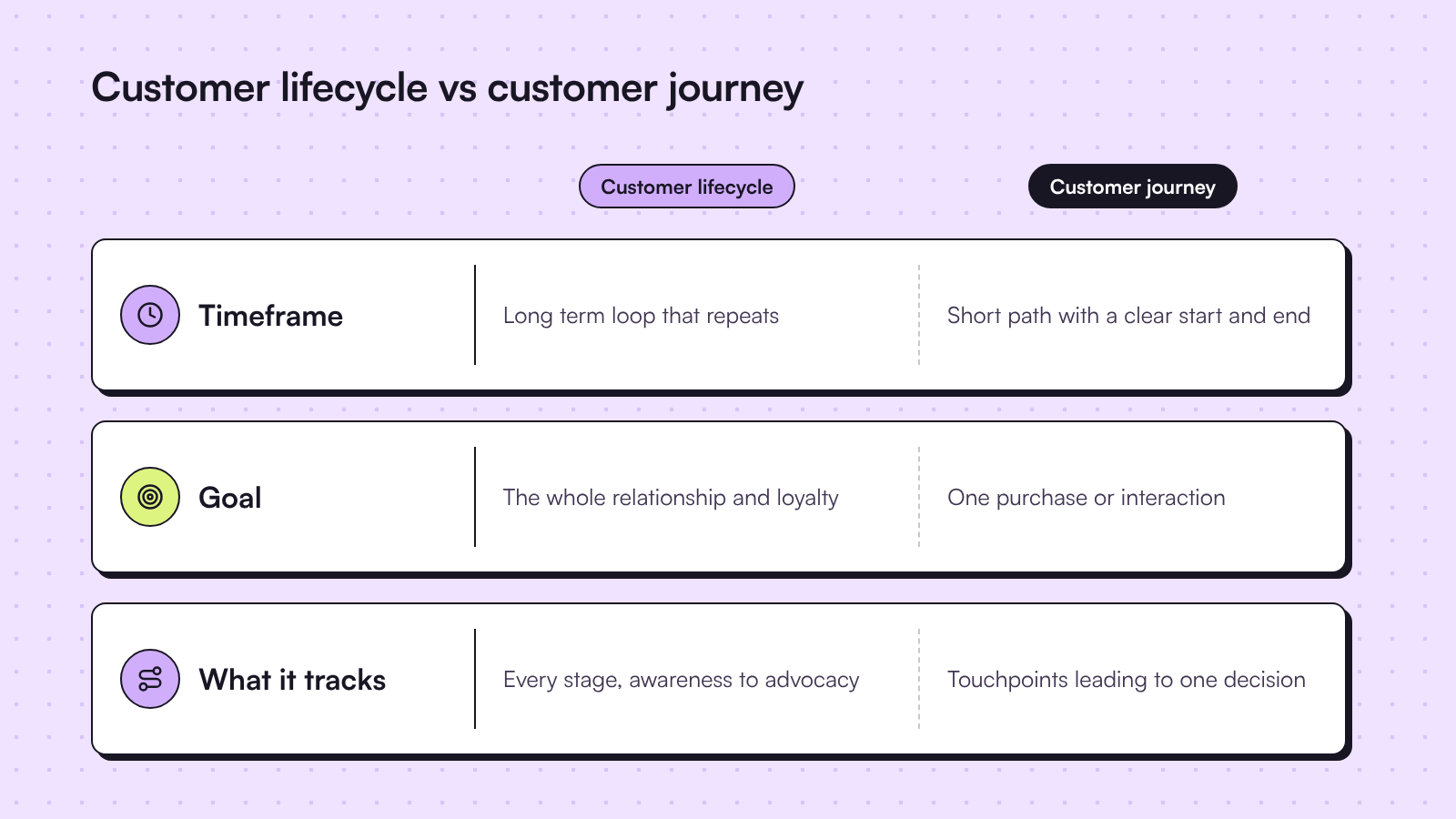
3 Major Differences Between Customer Lifecycle & Customer Journey
Learned the differences? Now let’s check out 3 major differences of customer lifecycle vs journey.
Timeframe:
Customer lifecycle is a long-term loop, and the journey is short with 3 specific parts.
Goal:
Lifecycle is about overall customer relationship, journey is about a single purchase or interaction.
Trackpoint:
Lifecycle tracks different stages from awareness to advocacy, journey tracks some definite touchpoints with the business.
Customer Lifecycle Vs Customer Journey: Which One Should You Optimize More?
Both are important, but focusing on the customer journey stages can often lead to bigger improvements. By defining specific steps customers take, you can make changes to improve their experience and increase sales.
However, when you think of a greater conversion rate, prioritizing the customer lifecycle helps a lot. Besides, customer lifecycle mapping helps you focus more on customer retention and loyalty, which in the end, maximizes revenue to a greater extent.
Depending on your business state and goal, you need to find out which one you should optimize more.
Frequently asked questions
What is the main difference between customer lifecycle and customer journey?
Scope. The lifecycle tracks the full relationship over time and repeats with every purchase. The journey tracks the touchpoints behind a single purchase or goal, so it has a clear start and end.
What are the 5 stages of the customer lifecycle?
Awareness, consideration, conversion, retention and loyalty. Loyal customers often turn into advocates who bring in new buyers, which restarts the cycle.
What are the stages of the customer journey?
Most journey maps use three: awareness (the customer discovers the brand), consideration (they compare options) and decision (they complete the purchase).
Is the customer journey part of the customer lifecycle?
Yes. Every purchase or key action is one journey, and the lifecycle strings those journeys together across the whole relationship.
What is an example of a customer lifecycle?
Say you spot a backpack brand on social media (awareness), compare it with others (consideration) and buy one (conversion). A follow up discount brings you back for a second bag (retention), and you start recommending the brand to friends (loyalty).
How do you track the customer lifecycle and customer journey?
Combine web and product analytics. Funnels and Path Analysis show where a journey breaks, while Cohorts and Accounts in Statwide show how customers move through lifecycle stages over time. Customer behavior analytics then ties those signals to revenue.
Wrapping Up
Knowing how your customers feel and what they do is significant for any business. To win big, you need to understand your customers whole journey, from the moment they hear about you to the end of your friendship. And that’s when you can identify which marketing strategies you need to apply to increase conversion rate of your business.
However, most often, people interchange the customer journey with the customer lifecycle. In simple words, customer journey is just some specific steps from discovering your business to completing the purchase whereas customer lifecycle represents the entire interactions of the customer with the business.
Hopefully, after reading the article on customer lifecycle vs customer journey, you can now have a clear picture of which one is your major priority now.